Who Is the Art M Who Prepares the Sunday Report
| Palm Sunday | |
|---|---|
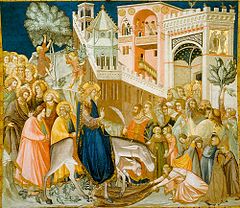 Entry of Christ into Jerusalem (1320) by Pietro Lorenzetti: entering the urban center on a donkey symbolizes arrival in peace rather than as a war-waging king arriving on a horse.[1] [2] | |
| As well called | 6th Sun of Lent |
| Observed by | Christians |
| Significance | commemorates Christ'south triumphal entry into Jerusalem; first day in Holy Week |
| Observances | Church omnipresence, blessing and distribution of palms, church processions, weaving palm crosses, hanging palm branches obtained from church liturgies behind Christian artwork or placing palm branches in Bibles and daily devotional books |
| Date | Moveable feast, Sunday before Easter |
| 2021 date |
|
| 2022 date |
|
| 2023 date |
|
| 2024 date |
|

Pocket-sized crosses woven from blessed palms, are often distributed at churches on Palm Sunday.
Palm Sunday is a Christian moveable feast that falls on the Sunday before Easter. The feast commemorates Christ's triumphal entry into Jerusalem, an effect mentioned in each of the four canonical Gospels.[iii] Palm Sunday marks the first day of Holy Week. For adherents of mainstream Christianity, it is the last week of the Christian solemn season of Lent that precedes the arrival of Eastertide.[four] [five]
In most liturgical churches, Palm Sun is celebrated past the blessing and distribution of palm branches (or the branches of other native trees), representing the palm branches which the oversupply scattered in front end of Christ every bit he rode into Jerusalem; these palms are sometimes woven into crosses. The difficulty of procuring palms in unfavorable climates led to their substitution with branches of native trees, including box, olive, willow, and yew. The Lord's day was frequently named after these substitute trees, as in Yew Sunday, or by the full general term Branch Sunday. In Syriac Christianity it is oft called Oshana Sunday or Hosanna Sunday based on the biblical words uttered past the oversupply while Jesus entered Jerusalem.
Many churches of mainstream Christian denominations, including the Orthodox, Catholic, Lutheran, Methodist, Anglican, Moravian and Reformed traditions, distribute palm branches to their congregations during their Palm Dominicus liturgies. Christians take these palms, which are frequently blessed by clergy, to their homes where they hang them aslope Christian art (especially crosses and crucifixes) or go on them in their Bibles and daily devotional books.[6] In the menses preceding the adjacent yr's Lent, known as Shrovetide, churches often place a handbasket in their narthex to collect these palms, which are then ritually burned on Shrove Tuesday to make the ashes to be used on the following day, Ash Wednesday, which is the first day of Lent.[vii] [viii]
Biblical basis and symbolism [edit]

In the accounts of the 4 canonical Gospels, Christ'south triumphal entry into Jerusalem takes place a calendar week before his resurrection.[9] [10] [11] [12] Just the Gospel[13] of John shows a timeline of the event, dated six days before the Passover.[fourteen]
The raising of Lazarus is mentioned only by the Gospel of John, in the previous chapter. The Eastern Orthodox Church and the Eastern Catholic Churches which follows the Byzantine Rite, commemorate it on Lazarus Saturday, following the text of the Gospel. In fact, the Jewish agenda dates begin at sundown of the night beforehand, and conclude at nightfall.[15]
The Gospel of Matthew states that this happened that the prophecy might be fulfilled of: Zechariah 9:9[sixteen] "The Coming of Zion'southward King – Run across, your king comes to yous, righteous and victorious, lowly and riding on a donkey, on a filly, the foal of a donkey".[17] Information technology suggests that Jesus was declaring he was the Rex of Israel.
According to the Gospels, Jesus Christ rode on a donkey into Jerusalem, and the jubilant people there laid down their cloaks and small branches of trees in front of him, singing part of Psalm 118: 25–26[18] – Blessed is He who comes in the name of the Lord. Nosotros bless you from the firm of the Lord.[ii] [9] [ten] [xi]
The symbolism of the donkey may refer to the Eastern tradition that it is an animal of peace, unlike the horse which is the creature of war.[one] A king would have ridden a equus caballus when he was aptitude on war and ridden a donkey to symbolize his arrival in peace. Christ's entry to Jerusalem would take thus symbolized his entry every bit the Prince of Peace, non as a war-waging male monarch.[1] [ii] Thus at that place have been two dissimilar meanings (or more than levels of biblical hermeneutics): an historical meaning, truly happening according to the Gospels, and a secondary significant in the symbolism.

In Luke 19:41 every bit Jesus approaches Jerusalem, he looks at the metropolis and weeps over information technology (an outcome known as Flevit super illam in Latin), foretelling his coming Passion and the suffering that awaits the urban center in the events of the destruction of the 2nd Temple.[nineteen]
In many lands in the ancient Almost East, information technology was customary to cover in some way the path of someone thought worthy of the highest honour. The Hebrew Bible[20] reports that Jehu, son of Jehoshaphat, was treated this way. Both the Synoptic Gospels and the Gospel of John study that people gave Jesus this form of laurels. In the synoptics the people are described equally laying their garments and cut rushes on the street, whereas John specifies fronds of palm (Greek phoinix). In Jewish tradition, the palm is 1 of the 4 Species carried for Sukkot, as prescribed for rejoicing in Leviticus 23:xl.[21]
In the Greco-Roman culture of the Roman Empire, which strongly influenced Christian tradition, the palm branch was a symbol of triumph and victory. It became the most common attribute of the goddess Nike or Victoria.[22] [23] [24] For gimmicky Roman observers, the procession would have evoked the Roman triumph,[25] when the triumphator laid down his arms and wore the toga, the civilian garment of peace that might exist ornamented with emblems of the palm.[26] Although the Epistles of Paul refer to Jesus as "triumphing", the entry into Jerusalem may non have been regularly pictured as a triumphal procession in this sense before the 13th century.[27] In aboriginal Egyptian organized religion, the palm was carried in funeral processions and represented eternal life. The martyr's palm was later used as a symbol of Christian martyrs and their spiritual victory or triumph over death.[28] In Revelation 7:nine, the white-clad multitude stand before the throne and Lamb holding palm branches.[29]
Observance in the liturgy [edit]
| Year | Western | Eastern |
|---|---|---|
| 2015 | March 29 | Apr 5 |
| 2016 | March twenty | Apr 24 |
| 2017 | Apr nine | |
| 2018 | March 25 | April 1 |
| 2019 | April 14 | April 21 |
| 2020 | April five | April 12 |
| 2021 | March 28 | April 25 |
| 2022 | April 10 | Apr 17 |
| 2023 | April 2 | April 9 |
| 2024 | March 24 | Apr 28 |
| 2025 | April thirteen | |
| 2026 | March 29 | April 5 |
| 2027 | March 21 | April 25 |
| 2028 | April ix | |
| 2029 | March 25 | April 1 |
Eastern and Oriental Christianity [edit]
Palm Sunday, or the Entry of the Lord into Jerusalem as information technology may be chosen in Orthodox Churches, is one of the Twelve Great Feasts of the liturgical year. The twenty-four hours before Palm Dominicus, Lazarus Saturday, believers often set palm fronds by knotting them into crosses in preparation for the procession on Sunday. The hangings and vestments in the church are inverse to a festive color – nearly commonly greenish.
The Troparion of the Feast (a short hymn) indicates that the resurrection of Lazarus is a prefiguration of Christ's Resurrection:
O Christ our God
When Thou didst enhance Lazarus from the expressionless before Thy Passion,
Thou didst confirm the resurrection of the universe.
Wherefore, we like children,
carry the banner of triumph and victory,
and nosotros cry to Thee, O Conqueror of death,
Hosanna in the highest!
Blessed is He that cometh
in the Name of the Lord.
In the Russian Orthodox Church, Ukrainian Orthodox Church building, Ukrainian Catholic Church building, Ruthenian Cosmic Church building, Polish, Bavarian and Austrian Roman Catholics, and various other Eastern European peoples, the custom developed of using pussy willow and other twigs like box tree instead of palm fronds because the latter are not readily bachelor that far northward. There is no canonical requirement equally to what kind of branches must be used, so some Orthodox believers use olive branches. Whatsoever the kind, these branches are blessed and distributed together with candles either during the All-Night Vigil on the Eve of the Feast (Saturday night), or earlier the Divine Liturgy on Sunday morn. The Bang-up Entrance of the Divine Liturgy commemorates the "Entry of the Lord into Jerusalem", so the meaningfulness of this moment is punctuated on Palm Dominicus as anybody stands, belongings their branches and lit candles. The faithful take these branches and candles dwelling with them after the liturgy, and keep them in their icon corner as an evloghia (approval).
In Russian federation, donkey walk processions took place in different cities, only most importantly in Novgorod and, from 1558 until 1693, in Moscow. These were prominently featured in testimonies by foreign witnesses and mentioned in contemporary Western maps of the city. The Patriarch of Moscow, representing Christ, rode on a "donkey" (actually a horse draped in white fabric); the Tsar of Russian federation humbly led the procession on foot. Originally, Moscow processions began within the Kremlin and terminated at Trinity Church, at present known as Saint Basil'due south Cathedral, simply in 1658 Patriarch Nikon reversed the order of procession. Peter I in the 1720s, as a office of his nationalisation of the church, terminated the custom; it has been occasionally recreated in the 21st century.
In Oriental Orthodox churches, palm fronds are distributed at the front of the church building at the sanctuary steps. In India the sanctuary itself is strewn with marigolds, and the congregation proceeds through and outside the church.
- Palm Sunday in Eastern and Oriental Christianity
-
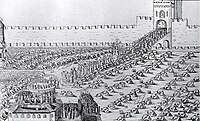
The Palm procession in Moscow, 1654, showing the original rite of the Russian church with a Donkey walk
-
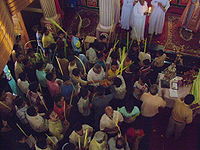
Orthodox congregation in India collects palm fronds for procession: men on left of sanctuary in the photo; women collecting fronds on right of sanctuary, outside photo.
-

Western Christianity [edit]

In ancient times, palm branches symbolized goodness and victory. They were often depicted on coins and important buildings. Solomon had palm branches carved into the walls and doors of the temple.[xxx] Again at the cease of the Bible, people from every nation raise palm branches to honor Jesus.[31]
Palm Lord's day commemorates the entrance of Christ into Jerusalem,[32] when palm branches were placed in his path, before his arrest on Holy Th and his crucifixion on Good Friday. It thus marks the starting time of Holy Calendar week, the concluding week of Lent.
In churches of many Christian denominations, members of the congregation, oft children, are given palms that they behave as they walk in a procession around the within of the church building.[33] [34] In the Church of Islamic republic of pakistan, a united Protestant Church, the faithful on Palm Sunday carry palm branches into the church as they sing Psalms 24.[35]
In the Roman Catholic Church, also as among many Anglican and Lutheran congregations, palm fronds (or in colder climates some kind of substitutes) are blessed with holy h2o exterior the church building (or in cold climates in the narthex when Easter falls early in the year) in an effect called the Blessing of the Palms. A solemn procession of the unabridged congregation takes place immediately afterwards the blessing of the palms, called the Palm procession.
In the Catholic, Lutheran, and Episcopalian traditions, this banquet now coincides with that of Passion Lord's day, which is the focus of the Mass which follows the procession. The Catholic Church considers the blest palms to be sacramentals. The vestments for the 24-hour interval are deep reddish red, the color of blood, indicating the supreme redemptive sacrifice Christ was entering the city to make, to fulfill his passion and resurrection in Jerusalem.


Palm Lord's day and other named days and day ranges around Lent and Easter in Western Christianity, with the fasting days of Lent numbered
In the Episcopal and many other Anglican churches and in Lutheran churches, also, the twenty-four hour period is officially chosen The Sunday of the Passion: Palm Sunday; in exercise, though, information technology is usually termed Palm Dominicus as in the 1928 American Volume of Common Prayer and in earlier Lutheran liturgies and calendars, to avoid undue confusion with the penultimate Sun of Lent in the traditional calendar, which was Passion Sunday.
In traditional usage of the Methodist Church, The Book of Worship for Church building and Home (1965) provides the following Collect for Palm Sun:[36]
Almighty and everlasting God, who, of thy tender love toward mankind hast sent thy Son our Savior Jesus Christ to accept upon him our flesh, and to suffer death upon the cross, that all mankind should follow the example of his great humility: Mercifully grant that nosotros may both follow the instance of his patience and also be made partakers of his resurrection; through the same Jesus Christ our Lord. Amen.[36]
Community [edit]
Information technology is customary in many churches for worshippers to receive fresh palm leaves on Palm Sunday. In parts of the earth where this has historically been impractical, substitute traditions have arisen.
Belgium [edit]
In Hoegaarden, ane of the concluding remaining Palm Sunday processions takes place every yr. A fellowship of Twelve Apostles carries a wooden statue of Christ around the town, while children go door to door offering the palms (box) for coins.[37]
Bulgaria [edit]
In Republic of bulgaria, Palm Sunday is known every bit Tsvetnitsa ( tsvete , "bloom") or Vrabnitsa (varba, "willow"), or Flower's Day. People with flower-related names (e.chiliad., Bilyan(a), Liliya, Margarita, Nevena, Ralitsa, Rosa, Temenuzhka, Tsvetan(a), Tsvetelin(a), Tsvetin(a), Tsvetko, Violeta, Yavor, Zdravko, Zjumbjul, etc.) gloat this day as their name day.[38]
England [edit]
In the 15th through the 17th centuries in England, Palm Sunday was often marked by the burning of Jack-'o'-Lent figures. This was a straw figure which would exist stoned and driveling on Ash Wed, and kept in the parish for called-for on Palm Sunday. The symbolism was believed to exist a kind of revenge on Judas Iscariot, who had betrayed Christ. The figure could also take represented the hated figure of Wintertime, whose destruction prepares the manner for Spring.[39]
Egypt and Ethiopia [edit]
In the Coptic Orthodox Church and Orthodox Ethiopia, this holiday is referred to as Hosanna. Palm leaves will be blessed and distributed, they are used to create crucifixes, rings and other ornaments.
Finland [edit]
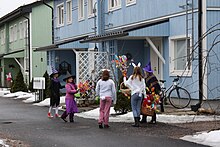
Easter witches in Finland
In Republic of finland, it is popular for children to dress upwardly as Easter witches and become door to door in neighborhoods and trade busy pussy willow branches for coins and processed. This is an old Karelian custom called virpominen.
It is customary for the children to dirge, with some variation, "Virvon varvon tuoreeks, terveeks, tulevaks vuodeks, vitsa sulle, palkka mulle!"[40] which translates as "I'm wishing you a fresh, good for you upcoming year, a co-operative for you, a prize for me!" The chant has been translated in Juha Vuorinen's novel Totally Smashed! equally "Willow switch, I'm the Easter witch! I wish you lot wellness and a honey that'south rich! From me I bring some luck today, for this branch what will you pay?"[41]
Federal republic of germany [edit]

In some regions of Germany, long stakes with pussy willow, box and other twigs are taken for the Palm procession rather than nosegays. In some Southern regions either the priest leads the palm procession, riding on a donkey, or a wooden donkey (called Palmesel) with a figure of Christ is traditionally trundled with the procession of the faithful.
India [edit]
In most of the Cosmic churches in India the palms are blessed by the priest on Palm Lord's day and then distributed among the people later the holy mass. There is a tradition of folding palm fronds into palm crosses, which are kept at the chantry till the next Ash Wednesday.
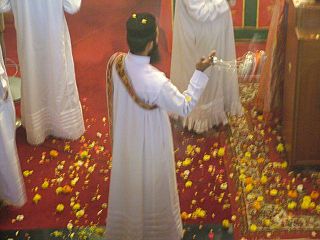
In the South Indian state of Kerala (and in Indian Orthodox, Church of South Republic of india (CSI), Syro-Malankara Cosmic Church building, and Syriac Orthodox Church (Jacobite) congregations elsewhere in India and throughout the West), flowers are strewn about the sanctuary on Palm Sunday during the reading of the Gospel, at the words uttered by the crowd welcoming Jesus, "Hosanna! Blessed is he who is come and is to come up in the name of the Lord God". These words are read to the congregation thrice. The congregation then repeats, "Hosanna!", and the flowers are scattered, a common custom in Indian celebrations. This symbolizes Jesus' triumphant entry into Jerusalem.
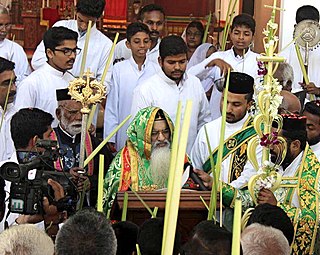
Indian Orthodoxy traces its roots to the arrival in India of Saint Thomas the Apostle (traditionally dated to Advertising 52) and his evangelism among both the Brahmans of the Malabar Declension and the ancient Jewish community in that location. Its rites and ceremonies are Jewish, Indian and Levantine Christian, in origin. In Syro-Malabar Cosmic Church building's palm leaves are blessed during Palm Sunday anniversary and a Procession takes identify holding the palms.[42]
Ireland [edit]
In Ireland'south common cold climate, real palm leaves are generally not available, so yew, silver fir, spruce or cypress are used instead; information technology is known in Irish as Domhnach an Iúir, "Yew Sunday."[43] [44] The historian Patrick Weston Joyce noted that yew was e'er called "palm" in his 1830s childhood, and he merely later learned the tree's right name. "Palm" branches were oft worn in the buttonhole or hung on the wall; the second practise is still common, and palm branches are blessed with holy water at Catholic Masses.[45] In the past in some areas, a palm stem was charred and a cross was marked on eggs set for hatching, while in parts of Counties Galway and Mayo, shredded palm was mixed through the seed grain. The coincidence of Palm Sunday and Saint Patrick'southward Twenty-four hour period (March 17), when "when the shamrock and the palm are worn together," was said to presage a great event; this last happened in 1940, at the beginning of the Second World War, and volition non reoccur until 2391.[44] [46]
Italian republic [edit]
In Italy, palm leaves are used along with small olive branches, readily available in the Mediterranean climate. These are placed at house entrances (for instance, hanging above the door) to last until the post-obit year'south Palm Sunday. For this reason, usually palm leaves are not used whole, due to their size; instead, foliage strips are braided into smaller shapes. Small olive branches are besides often used to decorate traditional Easter cakes, along with other symbols of birth, similar eggs.[ citation needed ]
Latvia [edit]
In Latvia, Palm Sunday is called "Pussy Willow Sunday", and pussy willows – symbolizing new life – are blest and distributed to the faithful.[47] Children are often awakened that morning time with ritualistic swats of a willow co-operative.[ citation needed ]
Republic of lithuania [edit]
When Christianity came to Lithuania, the plants which sprouted earliest were honored during spring feasts. The name "Palm Dominicus" is a misnomer; the "verba" or "dwarfed spruce" is used instead. According to tradition, on the Saturday before Palm Sunday the Lithuanians take special intendance in choosing and cutting well-formed branches, which the women-folk decorate with flowers. The flowers are meticulously tied onto the branches, making the "Verba".[ citation needed ]
The Levant [edit]
In State of israel, Jordan, Lebanese republic, Palestine, and Syria, Palm Sunday (Shaa'nineh in Arabic) Is possibly the best-attended liturgy in the Christian Calendar, amidst the Orthodox, Catholic (Latin and Eastern), and Anglican Churches, perhaps because it is notably a family occasion.[ citation needed ] On this day, children attend church with branches from olive and palm trees. Besides, there will exist carefully woven crosses and other symbols made from palm fronds and roses and a procession at the starting time of the liturgy, during which at some point, the priest will accept an olive co-operative and splash holy water on the faithful.[ citation needed ]
Malta [edit]
All the parishes of Malta and Gozo on Palm Sunday (Maltese: Ħadd il-Palm) anoint the palm leaves and the olive leaves. Those parishes that have the statues of Good Friday bless the olive tree they put on the statues of "Jesus prays in the Olive Garden" (Ġesù fl-Ort) and the "Betrayal of Judas" (il-Bewsa ta' Ġuda). Also, many people take a small olive branch to their homes because it is a sacramental.[ citation needed ]
Netherlands [edit]
In the Saxon regions of the Netherlands, crosses are busy with candy and bread, made in the form of a rooster. In the Diocese of Groningen-Leeuwarden, a great procession with oil lamps is held the night before Palm Dominicus in laurels of the Sorrowful Mother of Warfhuizen.[ citation needed ]
Philippines [edit]

In the Philippines, a statue of Christ riding a ass (the Humenta), or the presiding priest on horseback, is brought to the local church in a morning procession. Congregants line the route, waving palaspás (ornately woven palm branches) and spreading tapis (heirloom "aprons" fabricated for this ritual) in fake of the excited Jerusalemites. At the church parvise, a business firm, or the town plaza, children dressed as angels scatter flowers as they sing the day's antiphon Hosanna Filio David in the colloquial and to traditional tunes. The showtime Mass of the day and then follows.
Once blest, the palaspás are brought dwelling house and placed on altars, doorways, and windows. The Church teaches that this is a sign of welcoming Christ into the home, but folk belief holds that the blessed palaspás are apotropaic, deterring evil spirits, lightning, and fires. Another folk custom is to feed pieces of blessed palaspás to roosters used in sabong (cockfighting); this was strongly discouraged past the Archbishop of Manila, Cardinal Luis Antonio Tagle.[ citation needed ] In other provinces, the flowers strewn by the angels during the procession are added to the rice seeds being planted, in the conventionalities that these will ensure a bountiful harvest.
Poland [edit]

Many Polish towns and villages (the best known are Lipnica Murowana in Lesser Poland and Łyse) organize artificial palm competitions. The biggest of those reach above 30 meters in length; for case, the highest palm in 2008 was 33.39 meters.[48]
Romania and Moldova [edit]
In Romania and Moldova, Palm Sunday is known as Duminica Floriilor or simply Florii, translating Flowers' Sunday.[ citation needed ]
Kingdom of spain [edit]
In Spain, there is a tradition at the Palmeral of Elche (Europe's largest palm grove) in which local people cover palm leaves from the sun to let them to whiten, then they necktie and braid them into intricate shapes. [49]
A Castilian rhyming maxim states: Domingo de Ramos, quien no estrena algo, se le caen las manos ("On Palm Dominicus, the hands drop off of those who neglect to wearable something new"). On Palm Sunday, it is customary to don new wear or shoes.[50]
Syria [edit]
In Syria, it is popular for children to dress up every bit Easter witches and get door to door in neighborhoods for coins and candy.[51]
Wales [edit]

These Flowering Sunday grave decorations were photographed in South Wales circa 1907
In southern Wales and nearby portions of England, 'Sul y Blodau' or 'Flowering Sunday' is a grave decoration tradition unremarkably observed on Palm Sunday, although historically Flowering Sun grave decoration was also observed on other days as well. Today, the names Palm Sunday and Flowering Sunday are used interchangeably in those regions. In 1829 Thomas Wallace, of Llanbadoc, Monmouthshire, published a poem which contains the first known reference to the custom existence adept only on Palm Dominicus.
Welsh cemetery cleaning and decoration traditions may accept begun every bit an Easter celebration before becoming more normally associated with Palm Sunday. Every bit early as 1786, cleaning and bloom decorations were attested past William Matthews during a bout of Southward Wales.[52] Richard Warner attested in 1797 "the ornamenting of the graves of the deceased with diverse plants and flowers, at certain seasons, past the surviving relatives" and noted that Easter was the most popular time for this tradition. By 1803, Malkin's observations in "The Scenery, Antiquities, and Biography of South Wales from materials collected during two excursions in the year 1803" reflect the shift away predominantly associating the custom with Easter.[53]
See also [edit]
- Crucifixion eclipse
- Divine Mercy Sun
- Palm branch (symbol)
- Holy days inside the season of Lent
References [edit]
- ^ a b c Matthew 19–28 by William David Davies, Dale C. Allison 2004 ISBN 0-567-08375-vi p. 120
- ^ a b c John 12–21 by John MacArthur 2008 ISBN 978-0-8024-0824-2 pp. 17–18
- ^ Marking 11:ane–11, Matthew 21:ane–11, Luke nineteen:28–44, and John 12:12–19.
- ^ Cooper, J.C. (23 Oct 2013). Lexicon of Christianity. Routledge. p. 124. ISBN9781134265466. Archived from the original on v July 2014. Retrieved 25 April 2014.
Holy Week. The final week in LENT. Information technology begins on PALM Sun; the fourth day is called SPY Wednesday; the fifth is MAUNDY Th; the sixth is GOOD Fri; and the terminal 'Holy Sabbatum', or the 'Great Sabbath'.
- ^ Brewer, Ebenezer Cobham (1896). The Historic Notebook: With an Appendix of Battles. J. B. Lippincott. p. 669. Archived from the original on five July 2014. Retrieved 25 Apr 2014.
The concluding seven days of this menstruum found Holy Week. The first 24-hour interval of Holy Week is Palm Sunday, the fourth day is Spy Wed, the fifth Maundy Thursday, the sixth Good Fri, and the last Holy Sat or the Smashing Sabbath.
- ^ Kirk, Lisa (25 March 2018). "Ideas for Displaying Palm Sun Palms Effectually Your Habitation". Blessed Is She. Retrieved 4 April 2020.
- ^ "This Lord's day at Grace: February 4, 2018". Grace Episcopal Church. 3 February 2018. Retrieved 4 April 2020.
- ^ "Shrove Tuesday". The Times-Reporter. 18 Feb 2020. Retrieved iv April 2020.
- ^ a b The people's New Testament commentary past M. Eugene Boring, Fred B. Craddock 2004 ISBN 0-664-22754-six pp. 256–258
- ^ a b The Bible Knowledge Groundwork Commentary: Matthew–Luke, Volume 1 by Craig A. Evans 2003 ISBN 0-7814-3868-3 pp. 381–395
- ^ a b The Synoptics: Matthew, Marking, Luke by Ján Majerník, Joseph Ponessa, Laurie Watson Manhardt 2005 ISBN 1-931018-31-6 pp. 133–134
- ^ The Bible knowledge groundwork commentary: John's Gospel, Hebrews–Revelation by Craig A. Evans ISBN 0-7814-4228-1 pp. 114–118
- ^ Matthew 21:1–11, Marker xi:i–xi, Luke nineteen:28–44, John 12:one–19
- ^ John 12:ane
- ^ "When Is Passover in 2018, 2019, 2020 and 2021?". Archived from the original on 18 March 2018. Retrieved 2 April 2018.
- ^ Zechariah 9:9
- ^ Gospel of Matthew 21:iv-5
- ^ Psalm 118: 25–26
- ^ Luke 19:41
- ^ two Kings 9:13
- ^ Leviticus 23:xl
- ^ Reidar Hvalvik, "Christ Proclaiming His Law to the Apostles: The Traditio Legis-Motif in Early Christian Art and Literature," in The New Attestation and Early Christian Literature in Greco-Roman Context: Studies in Award of David E. Aune (Brill, 2006), p. 432
- ^ Vioque, Guillermo Galán (2002). Martial, Book 7: A Commentary. Translated past J.J. Zoltowski. Brill. pp. 61, 206, 411.
- ^ Clark, Anna (2007). Divine Qualities: Cult and Community in Republican Rome . Oxford University Press. p. 162. ISBN978-0199226825.
- ^ Warren W. Wiersbe, The Wiersbe Bible Commentary (David C. Cook, 2007), p. 272.
- ^ Vioque 2002, p. 61.
- ^ John Pairman Brown, State of israel and Hellas (De Gruyter, 2000), vol. two, pp. 254ff.
- ^ Lanzi, Fernando; Lanzi, Gioia (2004). Saints and Their Symbols: Recognizing Saints in Fine art and in Popular Images. Translated by Matthew J. O'Connell. Liturgical Press. p. 25. ISBN978-0814629703.
- ^ Revelation vii:9
- ^ 1 Kings vi:29
- ^ Revelation 7:9
- ^ Matthew 21:one–9
- ^ "Palm Sunday Marks Get-go of Holy Week". www.christianpost.com. 28 March 2010. Archived from the original on 30 October 2019. Retrieved 30 October 2019.
- ^ Staff, Woman's 24-hour interval (4 March 2019). "When Is Palm Sunday? Here's Everything Yous Demand to Know". Adult female'south Twenty-four hours. Archived from the original on 30 October 2019. Retrieved thirty October 2019.
- ^ Psalms 24
- ^ a b The Book of Worship for Church and Home: With Orders of Worship, Services for the Administration of the Sacraments and Other Aids to Worship According to the Usages of the Methodist Church. Methodist Publishing Business firm. 1964. p. 101. Archived from the original on 12 June 2019. Retrieved 25 March 2017.
- ^ Towers), Cooper, Gordon (Charles Gordon (1994). Festivals of Europe. Detroit: Omnigraphics. ISBN9780780800052. OCLC 28422673.
- ^ "Palm Sunday". Archived from the original on 6 April 2020. Retrieved 27 March 2020.
- ^ Frood & Graves p. x
- ^ Väänänen, Vuokko (21 March 2016). "Virvon varvon tuoreeks terveeks…". Värtsilän verkkolehti. Värtsilän verkkolehti. Archived from the original on 26 September 2017. Retrieved 25 September 2017.
- ^ Vuorinen, Juha (2017). Totally Smashed!. Translated by Leonard Pearl. Diktaatori. p. 165. ISBN978-9525474756.
- ^ "National / Kerala : Traditional services mark Palm Dominicus". The Hindu. xviii April 2011. Retrieved x June 2012.
- ^ Joyce, P. W. (26 November 2019). "English As We Speak It in Republic of ireland". Proficient Press – via Google Books.
- ^ a b "Palm Sunday in old Ireland - World Cultures European". world wide web.irishcultureandcustoms.com.
- ^ Year, the Fading (28 March 2021). "Irish Folklore for Palm Lord's day – Domhnach an Iúir".
- ^ "5 Fascinating Irish Palm Sunday traditions y'all might not know about". Aleteia — Catholic Spirituality, Lifestyle, World News, and Culture. 9 Apr 2022.
- ^ "Archives". Mirabilis.ca. June 2012. Archived from the original on 27 Oct 2007.
- ^ "The Easter Palm Sun". Realpoland.eu. Archived from the original on 10 April 2017. Retrieved v April 2018.
- ^ "The metropolis of Elche, known for its craft tradition, in Spain is Culture". Spainisculture.com. Archived from the original on xv Oct 2017. Retrieved 5 April 2018.
- ^ Murtaugh, Taysha; Hanrahan, Laura (ix March 2020). "Need Some Easter Sun Outfit Ideas? Hither Are A Few Fashionable (and Affordable) Looks". Adult female'south Day . Retrieved fifteen May 2020.
- ^ Before the Syrian civil war (2011–present), authors documented the traditions east.g. in Tanya Gulevich, Encyclopedia of Easter, Carnival, and Lent (Bloomington: Indiana Academy: 2009), 345. ISBN 978-0780804326; and Patricia Lysaght, Food and Celebration: From Fasting to Feasting. Proceedings of the 13th Briefing of the International Committee for Ethnological Nutrient Enquiry, Ljubljana, Preddvor, and Piran, Slovenia, June 5–11, 2000 (Ljubljana: Založba, 2002), 155. ISBN 978-9616358545
- ^ Matthews, William (1786). The miscellaneous companions, Vol. I Being a brusk tour of observation and sentiment, through a part of South Wales. pp. fifty–51.
- ^ Malkin (1904). The Scenery, Antiquities, and Biography of S Wales from materials collected during two excursions in the year 1803. Embellished with views drawn on the spot and engraved by Laporte and a map of the county. pp. 67–69.
Bibliography [edit]
- Frood, J. D.; Graves, M. A. R. (1992). Seasons and Ceremonies: Tudor-Stuart England. Elizabethan Promotions.
- Вход Господень в Иерусалим. Богослужебные указания для священнослужителей. (Составитель протоиерей Виталий Грищук) – СПб.: Санкт-Петербургская православная духовная академия, 2013г. (в формате iBooks).
External links [edit]
- An Society of Service for Palm Sunday
- Larn how to make a cantankerous out of palms
- Palm Sunday (Greek Orthodox Archdiocese of Commonwealth of australia)
- Palm Sunday according to the Byzantine Rite Tradition
- Palm Sun 2015
- Herbermann, Charles, ed. (1913). . Catholic Encyclopedia. New York: Robert Appleton Company.
alvaradohonesided.blogspot.com
Source: https://en.wikipedia.org/wiki/Palm_Sunday
0 Response to "Who Is the Art M Who Prepares the Sunday Report"
Post a Comment